The UNESCO Digital Learning Week 2026 was again an extraordinary event! Exciting talks and discussions among more than 1,300 leading experts on this year’s motto: “Education in the age of AI: Facts | Frictions | Frontiers”!
One full week at the UNESCO Headquarters in Paris was dedicated to reflect whether and how education as common good can benefit from Artificial Intelligence (AI).
In her excellent Thursday keynote, Baroness Beeban Kidron from UK reminded us that we should begin with the children and the rest will follow. There are two simple reasons: our moral duty of care and strategic decision to give children more rights next to the human rights. If we give rules for AI and technology used by children, then we can discover our potential agency and maybe also rules for adults. Consequently, we should not aim for minimal viable AI products but for minimal viable AI regulation.
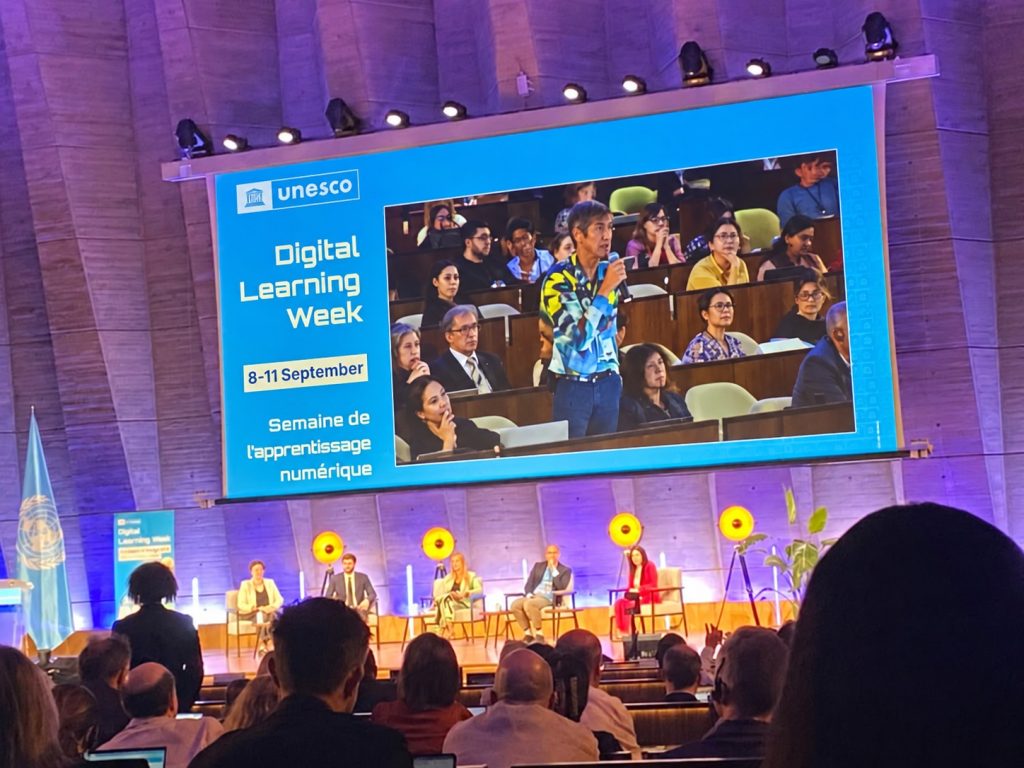
And the panelists of the following plenay discussion “Towards deliberative governance on learner safety in education” emphasized the need for an ethical AI regulation in their answers on my related question:
They confirmed the urgent need worldwide for regulating education with AI and education about AI.
In their lively Wednesday Fireside chat, Cristine Legare and Jason Lodge (both USA) had already focused metacognition as mandatory prerequisite before. Cristine underlined that learning occurs when interaction (with or without ai) is happening and thus, social learning is very important while AI prefers one style to think about learning. And Jason pointed out that interaction with AI is very different compared with other technologies and that humans learn better with and from other humans.
In the beginning, Sonia Linvingstone asked in her keynote the most important question: What is the right AI age? While the regulationsa are very different, we see more risks than benefits until now and have to define clear educational purposes first. My own question concerned the immense AI costs that are avoiding education support and investment.
This year, we were pleased to engage with all participants of the UNESCO Digital Learning Week 2026 in four interactive workshops on AI in education frictions or non-frictions hold in four languages (English, French, Spanish and Arabic). Organised by our UNESCO UniTwin Network on Open Education (UNOE: https://unitwin-unoe.org/), we could reflect 23 dilemmata in a game-based approach.
Finally, we had the opportunity to present our new research project ASSAI (https://assai-project.eu/) on policy development for AI-mediated assessment in education. All received feedback encourages us to concentrate on the ethical questions for the introduction of AI into formative and summative assessment that has completely to be changed.
Overall, it was extremely valuable to attend this truly international conference this year. A big Thank You goes to the great UNESCO organisers, among others: Keith Holmes, Sobhi Tawil and in particular Shafika Isaacs.
Therefore, I’m looking forward to meeting you at UNESCO Digital Learning Week 2027!