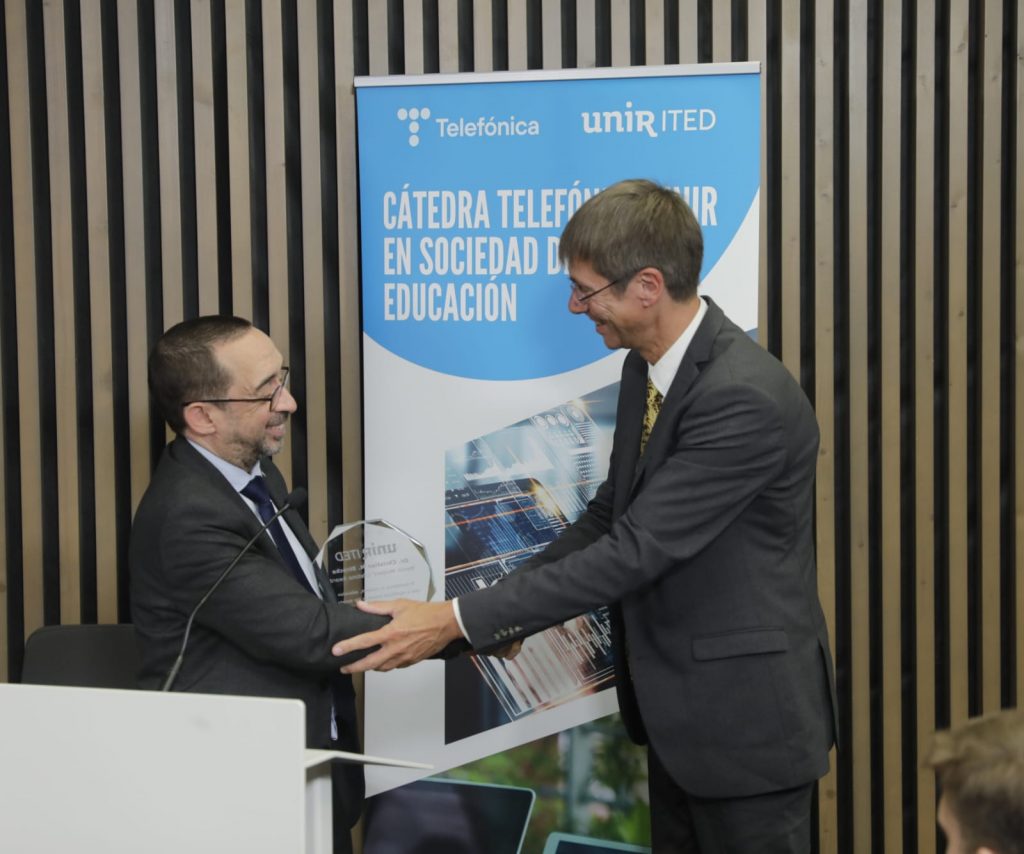
Appointed to global Hall of Fame

I’m very excited and honoured:

I have been selected as the 90th expert for the Leaders and Legends of Online Learning and inducted into the global Hall of Fame. What is unique about this is that the selection is only made by the other experts and colleagues worldwide. Marc Nichols started this project at the Open University of UK back in 2018 and has always recorded a podcast with all the appointed experts. In his questions, he is particularly interested in the personal long-term perspective.

In over 30 minutes, I describe my eventful career, international achievements and dedication to open and free education to strengthen societies and the common good worldwide. After starting my career with e-learning producers and HR consulting companies and as co-founder of the German E-Learning Association for Professional Providers (D-ELAN e.V.), I switched to scientific research. In my countless international activities and projects, I have been active on all five continents and worked primarily at universities in Europe and Asia. During my doctorate in economics and computer science, I remained true to my main topic, which I have continuously pursued for over 25 years: the quality and innovation of digital and open teaching and learning opportunities. Finally, I was appointed ICDE Chair and Associate Professor at the Open University of the Netherlands and I still holds professorships at the Korean National Open University in Seoul and at the East China Normal University in Shanghai.

Currently, I’m setting up a research line at the University of Bonn’s Scientific University IT and Data Centre that specializes in Open Education and Artificial Intelligence (AI). I analyse and evaluate the benefits of their application and combination in practice for the quality and innovation of school education, academic teaching and, above all, for the common good and society as a whole. Most recently, I was appointed by the Council of Europe as a member of the European AI&ED Expert Group, which is developing an EU law specifically on the use of AI in education to complement the AI Act.

EduTalk Recording is published by Council of Europe

The EduTalk of the Council of Europe on “Teaching and Learning with and about AI” was a huge success thanks to more than 100 participants!

On 19th of October 2023, I was very happy to discuss together with my colleagues the ethical dimensions of AI&ED. In particular we emphasized the importance and need to focus and regulate AI and Education (AI&ED).

All details about the EduTalk can be found on the Council of Europe website.

The recording of the EduTalk is published now, just click on the image below:


AI&ED Workshop at Council of Europe in Strasbourg

Council of Europe AI&ED Expert Group
CoE_AIED_Expert_Group

The AI&ED Expert Group was meeting at the Council of Europe in Strabourg for two-day interactive workshop. On Tuesday, 21st, and Wednesday, 22nd of November 2023, all experts were discussing the future AI&ED activities in Europe.

Main objective was the development and reflection of key elements and structures relevant for the planned European AI&ED legal regulation and accompanying recommendation on AI literacy.

All 20+ experts from all parts of Europe agreed on the need for a strong international convention that should also be adopted as legally binding instrument in Europe and all Council if Europe’s member states.

EduTalk on Teaching and Learning with and about AI

The Council of Europe invites to the EduTalk on Teaching and Learning with and about AI:

Artificial Intelligence is reshaping education, offering new opportunities for media creation, analysis, and decision-making. This transformation demands a re-evaluation of current teaching and assessment methods in light of AI’s black box nature and its integration into educational systems.

The upcoming EduTalk will delve into the potential applications of AI in supporting teaching and learning. It will scrutinize the challenges and benefits from both the learner and teacher perspectives. Additionally, the event will emphasize the prerequisites that must be met before introducing an AI-enabled technology/system in the classroom, with a particular focus on upholding human rights, democracy, and the rule of law.

Key questions:

  • How can AI be effectively integrated into educational curricula to promote AI literacy?
  • What ethical considerations should guide AI regulation in education to protect human rights and democracy?
  • How can teachers be supported in adapting to AI-enhanced teaching methods?
  • What strategies can be employed to ensure AI is used responsibly and creatively in the classroom?

Join on Zoom for the EduTalks@Council of Europe on Thursday 19 October at 17.00 CET to get answers to these and other questions.

I’m very pleased to be invited as speaker focusing on the ethical dimensions of AI&ED.

More details and registration on the Council of Europe website.

We are looking forward to our discussion!

Mandate for AI&ED Regulation by European Ministers

On 29th of September 2023, the European Ministers of Education set new priorities and actions to implement the Reyjkjavik Principles for Democracy at the 26th session of their Standing Conference. They endorsed the 2030 “Learners First” strategy and adopted five resolutions including the mandate for regulating Artificial Intelligence and education (AI&ED).

The AI&ED resolution consists of two major instruments to harness the potential of Artificial Intelligence (AI) in and through education: (1) an international convention as European law and (2) a recommendation on teaching and learning about AI.

The rationale for this mandate is provided in the regulation objectives for AI in education by the Council of Europe that were building the basis for the decision by the Standing Conference of the Ministries of Education from the 46 Member States of Council of Europe.

The first legal instrument should regulate the use of Artificial Intelligence systems in education to promote and to protect human rights, democracy and the rule of law as core values of the Council of Europe.

And the second instrument combines both approaches: ethical use of AI in education (AIED) and education about AI (AI literacy) incorporating the impact of AI on human rights, democracy and the rule of law and prioritising the active participation and agency of teachers and learners.

Through this resolution, the AI&ED Expert Group appointed by the Council of Europe can start working on both instruments. As selected AI&ED Expert Group member, I’m very proud and honoured to contribute my expertise for the European future of ethical and trustworthy AI and education.

Invited Keynote at IEC 2023 in Bangkok

The International E-Learning Conference (IEC) 2023 invited me to deliver the keynote on 1st of September 2023. I selected the title “Social changes for and through e-Learning and AI” for my keynote to address current and future challenges in education.

I’m convinced that digitalisation is a strong (if not the strongest) driver for social changes, not only in education.

E-Learning and Artificial Intelligence (AI) are challenging and changing our societies.

During the COVID-19 pandemic and lockdowns, e-Learning was often immediately and broadly introduced without any support and stable infrastructure leading to many problems and inequities.

Afterwards and in particular through the published ChatGPT and its global promotion, AI became popular and impacts now educational settings and systems by offering new opportunities to create media, analyses and decisions. However, the AI services, their black boxes, hallucinations, lacking responsibilities and ongoing integrations into other systems are mostly unclear and non-transparent.

As a consequence, we need to reflect and adapt our current teaching and learning opportunities, especially the grading and assessments with main focus on written examinations and theses.

And we should start the global discussion how e-Learning and AI can be used to strengthen human rights, democracy and rules of law instead of supporting biases, fake news and inequity.

AI&ED Expert Group appointed by Council of Europe

The Council of Europe has identified the urgent need to focus ethical Artificial Intelligence and education (AI&ED). Therefore, it has appointed the AI&ED Expert Group to support the development of European instruments and the information and discussion with all relevant stakeholders.

After a conference in 2022 and a first report on the current AI&ED situation, the Council of Europe decided to continue and strengthen the activities towards European approaches. Main objective is to safeguard and improve the European core values of human rights, democracy and the rule of law during the introduction and implementation of AI&ED.

Thus, I’m very proud and honoured to be selected and appointed by the Council of Europe as member of its AI&ED Expert Group. And I’m looking forward to our close collaborarion to regulate and enhance  AI&ED in both approaches: as ethical AI use in education (AIED) and as innovative teaching and learning about AI (AI literacy).

European Network “Ethical use of AI” established

The European Network “Ethical use of AI” is established!

Today, on 13th of July 2023, the European Network met for the very first time. It was founded due to the huge demand raised at the AIED Conference 2023 in Tokyo, Japan. Together with my colleagues from the AI&ED Expert Group of the Council of Europe, I was moderating a full-day workshop on AI and Education. And I was introducing the German Network “Ethical use of AI” that is monthly meeting for sharing and discussing current news and trends. Afterwards, I got many requests why such a network is not provided in English and as a consequence, I simply invited for the European Network (to avoid conflicts with time zone but open for everybody from all over the world, of course).

All details about the European Network “Ethical use of AI” can be found here:

http://ethicalai.ecompetence.eu/

Full-day Workshop at AIED 2023 in Tokyo

An interactive full-day workshop on ethical and trustworthy Artificial Intelligence (AI) and education at the 30th international AIED 2023 Conference: I’m not surprised and very encouraged that our proposal was selected in strong competition.  The full workshop title is: “AI and Education. A view through the lens of human rights, democracy and the rule of law. Legal and organizational requirements”. The workshop follows the World Café method and will be conducted in a highly interactive manner. It will take place on Monday, 3rd of July 2023 as a hybrid event at the AIED 2023 Conference in Tokyo, Japan, as well as online. The workshop is closely aligned with the AIED 2023 Conference theme – “AI in Education for Sustainable Society”. It will provide an arena for the AIED community to familiarise themselves with the CoE initiative and to engage in follow on activities.

It is obvious and demanded from latest publications, studies and events that AI in education and beyond requires legal and organizational regulations. Therefore, the Council of Europe (CoE) took action as it is the international organisation founded in 1949 to uphold human rights, democracy and the rule of law in Europe. Currently, it has 46 member states (19 more than the European Union), with a population of approximately 675 million. In 2021, the CoE established a first AI&ED Expert Group to investigate, and propose a legal instrument for, the application (AIED) and teaching (AL Literacy) of AI in education. The project, entitled, “Artificial Intelligence and Education”, is working towards developing an actionable set of recommendations for Member States, helping ensure that the application and teaching of AI in education is for the common good.

To that end, the CoE AI&ED Expert Group has researched and written an initial report (“AI and Education. A critical view through the lens of human rights, democracy and the rule of law.”) and undertaken a survey of Member States, both of which have been designed to inform the project and to stimulate further critical debate. Currently, the CoE AI&ED Expert Group is working on the analysis of the survey and developing the legal instrument. All workshop organizers are members of the CoE AI&ED Expert Group and/or were invited by the CoE and contributing to the CoE Expert Conference “Artificial Intelligence and Education” held by the CoE on 18th and 19th of October 2022 in Strasbourg.

The workshop intends to achieve these learning objectives:

  • To explore potential guidelines for trustworthy and ethical AI usage and to critically assess their structure and usage scenarios
  • To develop ideas around personal future ramifications (including trustworthiness and ethical implications) and AI usage in education, and to collate, present and discuss these
  • To explore in group work and in the plenary how legal guidelines for trustworthy and ethical AI usage can be developed and designed, in particular related to legal and organizational requirements
  • To identify methods for dealing with the quick changing developments in AI, providing a legal framework that is flexible but also appropriately effective

Therefore, these guiding aspects will be addressed:

  • How can we develop and implement legal and organizational requirements for ethical AI introduction and usage?
  • How can we keep and maybe even strengthen human rights, democracy, digital equity and rules of law through AI-supported education and learning opportunities?
  • And how can we involve all educational levels (micro, meso, macro) and stakeholders to guarantee a trustworthy and ethical AI usage?

Main focus will be on the legal and organizational requirements to achieve a regulation in the fields of AI and Education (AI&ED). Basis will be the work and activities of the Council of Europe (CoE) and its appointed AI&ED Expert Group and in particular its initial report. All these open and urgent issues will be discussed and next steps in relation to these requirements and goals will be defined.

More information on the website of the workshop:

http://aied2023.learning-innovations.eu/


PS: The workshop concept and key results are published in the AIED Conference proceedings now.

Invited Speech at European Parliament

I was invited to speak as international expert at the European Parliament and answer questions by the members of the European Parliament on 5th of December 2022. The two-day hearing took place in Paris, France under the leadership of Lord Earl of Dundee. Digital education was one main topic of the agenda for which I was asked to contribute. Together with colleagues from UNESCO and OECD, I was delivering answers on 17 topics that the European Parliament had provided and demanded before.

Overall, I was honoured and pleased to offer my long-term experiences and expertise to the European politicians. My key points and messages were focusing the current and future (digital) education and society:

In the future, face-to-face learning will remain very important. Distance learning will strongly decrease due to the fact that E-Learning will heavily increase thanks to more demands and opportunities, in particular through much more online learning (what is a sub-category of E-Learning).

The strengths and weaknesses of face-to-face and E-Learning (= digital learning) are the same and cannot separated: It always depends on the three main factors: learning objectives, target groups and situation. Only after their definitions the appropriate and best learning type (face-to-face or E-Learning) should be selected.

It is important to differentiate between learning (what can also happen informally without intentions, e. g. on general websites without educational purposes) and education that is always designed with specific learning objectives (and therefore, ‘informal education’ is not existing as it would be a contradiction).

We need to achieve a balance between the commons, the states and private business what is currently dominating, in particular in relation to the educational systems.

First trend: Online courses and learning materials are used more than before (but not that much as we expected from the COVID-19 lockdowns): Unfortunately, we are lacking longitudinal studies and research on online education in general.

Second trend: Open Educational Resources (OER) are a grass-root movement that is rapidly growing thanks to strong UNESCO support and the adopted UNESCO Recommendation on OER (2019), a milestone for future OER development.

Third trend: Open Education is the broad philosophy covering many dimensions and categories for innovating and improving (digital) education including OER).

To analyse the impact of COVID-19 lockdowns and to identify problems and solutions, we, a global group of 40 researchers, have collected and evaluated case studies from 13 countries. Our three research questions were related to: the situation in schools and universities, the usage and effects of Open Education to overcome lockdowns and the introduction of new instruments and tools during lockdowns.

Overall, we could identify 7 key aspects that were the same in (almost) all 13 countries. The specific results concerning the first two research questions are already published in the SSCI journals (Web of Science) Sustainability: https://doi.org/10.3390/su14031876 and IRRODL:
https://doi.org/10.19173/irrodl.v23i4.6120

My first recommendation for E-Learning is that it requires digital and pedagogical experts and competences. Before designing education and deciding on technologies, you need to address the given situation. Most important future tasks are digital and pedagogical competence building for teachers (and school leaders, pupils and parents) and infrastructure to ensure inclusion, equity and human right of education for all.

I hope that my speech and all provided answer can lead to an improvement of the digital and non-digital education in Europe for our common future and society.