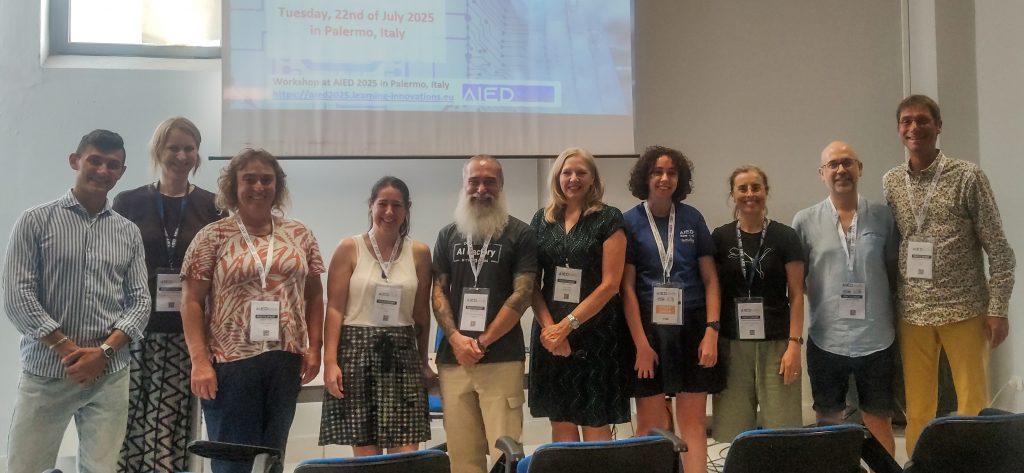
Invited Co-Chair at AIED 2025

I’m very honoured to be invited as Co-Chair for the PIP Track at AIED 2025!

The International Conference AI in Education (AIED) 2025 is organizing a combined Practitioners, Industry and Policy (PIP) track for the first time. The call for contributions is open until 17th of March 2025. All proposals will be peer-reviewed and selected contributions can present in a thematic session during the official program of the AIED 2025 Conference. The 26th International Conference on Artificial Intelligence in Education will take place in Palermo, Italy, from 22nd to 26th of July 2025.

This Call of the PIP track is not asking for scientific papers, but contributions on the role of AI in industry and society, in relation to educational challenges and opportunities. Thus, it is inviting practitioners, including teachers, educators, learners, education technology companies, product designers, and policy makers, to share AI in Education (AIED) examples and initiatives from industry, schools, higher education, workplaces, and society at-large. This track is therefore offering a low barrier of entry allowing researchers to learn from practitioners and policy makers, and allowing practice and policy to be enriched, in turn, by rigorous evidence-based research.

The call is open for contributions from a range of different educational contexts and professions to reflect the manifold implementations and perspectives in AIED. Next to researchers and learning designers, we especially invite AIED-related contributions from educators and learners, from industry and enterprise representatives as well as from policy makers, non-profit organizations and government bodies. To meet the call’s goals, we seek submissions that present implementations as well as strategies and policies on AIED. Proposed contributions should reflect on practical experiences with AI-supported education or bring together different stakeholders in this field. Most welcome are explicitly descriptions and reflections of practical implementations, strategies, and policies, and descriptions of personal experiences using AI in the educational domain from a practicing perspective.

All details about the Practitioners, Industry and Policy (PIP) track and its Call: https://aied2025.itd.cnr.it/index.php/maintrack/practitioners-industry-and-policy/

Webinar on Societal Impact of AI

I’m very pleased to hold a free webinar upon invitation by the Ministry of Education from Luxembourg!

My title: “The Societal Impact of AI”

The webinar takes place on Tuesday, 11th of March 2025 from 1 PM to 2 PM CET.
To join, you must register on the Moodle platform here: https://learning.eofai.lu

UPDATE: My slides are published now with an open and free license here:

https://doi.org/10.5281/zenodo.15009832

Results of the 2nd AI&ED Conference

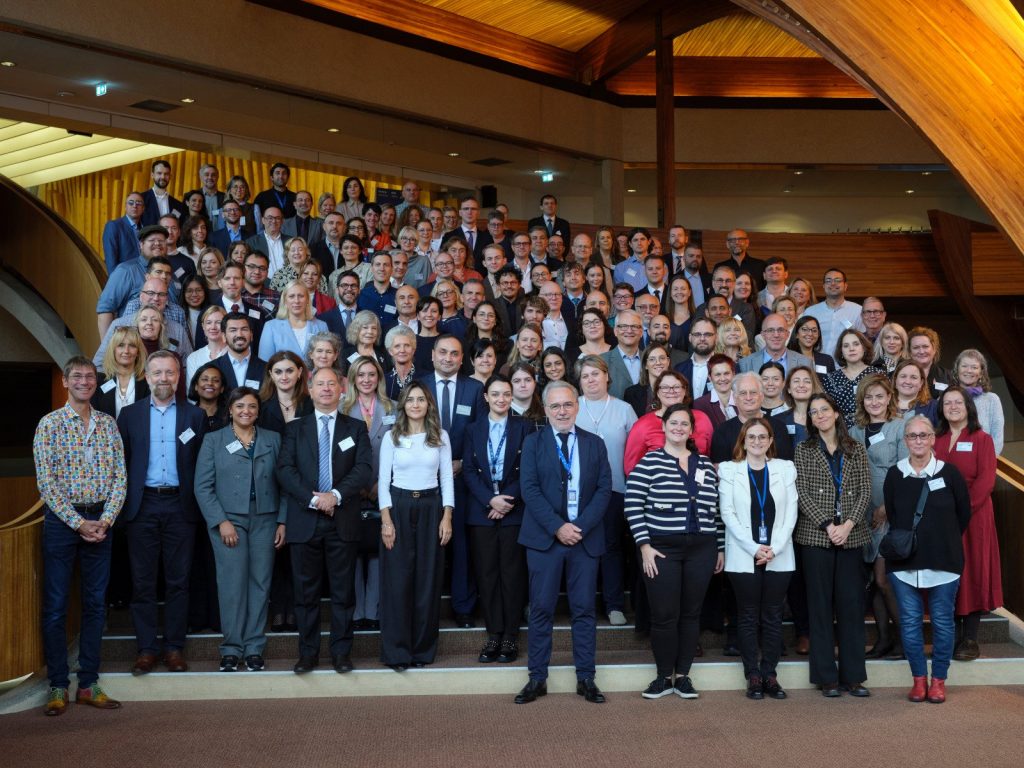
I was very pleased to co-organize the Second Conference “Regulating the Use of AI Systems in Education” on 24th and 25th of October 2024 in Strasbourg. During this interactive event, the Council of Europe invited all stakeholders to discuss the needs for international regulation of AI in education.

Overall, this 2nd AI&ED Conference was a huge success. It brought together all relevant stakeholder groups (researchers, teachers, students, enterprises, public authorities, policy makers and NGOs) which was considered as a strong asset and advantages. And a need for a 3rd Working Conference in 2025 was expressed to discuss in detail the upcoming proposals for the international AIED convention as binding legal instrument and the AI Literacy Toolbox that will be developed in the meantime.

The 2nd Conference facilitated a deep exchange of experiences and engaged discussions in the interactive sessions. While this combination was highly appreciated, many participants demanded for more general debates and group work dedicated to specific topics in parallel sessions. During a 3rd Conference in 2025, the sharing of experiences could be facilitated through pre-recorded videos and publication distributed in advance to allow more time for the general debates and group work collaboration.

In summary, the following recommendations were made:

  • Responsibility: In all AIED processes and aspects, there is always a human-to-human responsibility as the AI systems are developed, designed, implemented, offered and used by human beings with their specific responsibilities for the impacts of their activities.
  • Evidence: There is a strong need for evidence-based research to collect and analyse large-scale data and information about the impacts of AIED and AI Literacy implementations.
  • Holistic approach: The regulation of the AI use in Education (AIED) always requires the Education about AI (AI Literacy).
  • Policy makers: Representatives from CoE member states and their public authorities should present their ideas, proposals and action plans related to future AIED and AI Literacy.

Finally, the urgency of AI regulation in education as a special sector was confirmed: Current legal frameworks, such as GDPR and the EU AI Act, are insufficient to address education-specific challenges, particularly concerning children’s rights. It is important that the legal instrument for the AI regulation in education planned by the Council of Europe is aligned and complementary to the Council of Europe’s Framework Convention on Artificial Intelligence, as well as to serve the core values of the Council of Europe, namely: human rights, democracy, and the rule of law.

More information about the Programme of the 2nd AI&ED Conference by the Council of Europe: https://opening-up.education/second-conference-on-ai-regulation-in-education-by-the-council-of-europe

More information about the mandate of the Council of Europe for the AI regulation in education can be found here: https://opening-up.education/mandate-for-aied-regulation-by-european-ministers

Published: Our Generative AI Manifesto

Published now:

The Manifesto for Teaching & Learning in a Time of Generative AI: A Critical Collective Stance to Navigate the Future

Generative AI is reshaping higher education, offering tools to personalize learning, boost efficiency, and expand accessibility. But beneath the surface, it raises profound questions:

  • How do we maintain human oversight in algorithm-driven systems?
  • Are we safeguarding equity and amplifying diverse voices – or reinforcing biases?
  • How can we ensure that GenAI enhances, rather than erodes, creativity, critical thinking, and empathy in education?

This manifesto calls for thoughtful, evidence-based action to ensure GenAI empowers, rather than diminishes, our collective agency in education. Let’s reimagine the future of learning – ethically and inclusively.

📖 Read more: https://doi.org/10.55982/openpraxis.16.4.777

Written together with:

Aras Bozkurt , Junhong Xiao , Robert Farrow , John Bai , Chrissi Nerantzi , Stephanie L. Moore , Jon Dron , Christian M. Stracke , Lenandlar Singh , Helen Crompton , Apostolos Koutropoulos , Evgenii Terentev , Angelica Pazurek , Mark Nichols , Alexander Sidorkin , Eamon Costello , Steve Watson , Dónal Mulligan , Sarah Honeychurch , Charles Hodges , Mike Sharples , Andrew Swindell , Isak Frumin , Ahmed Tlili , Patricia J Slagter van Tryon , Melissa Bond , Maha Bali , Jing Leng , Kai Zang , Mutlu Cukurova , Thomas Chiu , Kyungmee Lee , Stefan Hrastinski, Manuel B. Garcia , Ramesh Sharma , Bryan Alexander , Olaf Zawacki-Richter , Henk Huijser , Petar Jandric , Chanjin Zhen , Peter Shea , Josep M Duart , Chryssa Themelis , Anton Vorochkov , Sunagül Sani Bozkurt , Rob Moore , Tutaleni I. Asino

Published: Open Education for Safe Generative AI

Published:

Taming the Monster: How can Open Education Promote the Effective and Safe use of Generative AI in Education?

We have converted the question: We should not ask how Generative AI can improve (Open) Education but how (Open) Education can improve Generative AI!

The development, use, and timely promotion of Open Education (OE) has been effective in addressing myriad educational concerns, including inclusivity, accessibility and learning achievement, among many others. However, limited information exists in the literature concerning how OE could enhance Generative Artificial Intelligence (GenAI), which is receiving extensive interest and criticism at this time. To address this research gap, this study relies on the Open Educational Practices (OEP) framework of Huang et al. (2020) to provide various OEP scenarios that could help to promote and facilitate the effective and safe adoption of GenAI in education. The findings of this study could provide guidelines on how relying on OEP when adopting GenAI could help in ensuring quality education which is the sustainable development goal (SDG 4) of the United Nations (UN).

📖 Enjoy reading: https://doi.org/10.56059/jl4d.v11i3.1657

Written together with:

Ahmed Tlili ,Michael Agyemang Adarkwah , Chung Kwan Lo , Aras Bozkurt , Daniel Burgos , Curtis J. Bonk , Eamon Costello , Sanjaya Mishra , and Ronghuai Huang

Martin Wolpers’ Lifetime Award

It was my huge honour and great pleasure to receive the Martin Wolpers’ Lifetime Award!

I got my first Lifetime Award from the Spanish Universidad Internacional de La Rioja (UNIR) at the AGORA Conference on Tuesday 22nd of October 2024 in Logroño.

It says on the trophy: “To excellence in research, education and a significant impact on society”. That are exactly the three objectives that I’m fully committed to during my lifetime.

I hope that I can continue contributing to the global commons, our society and open education for all!

More about my Lifetime Award:

http://research.unir.net/blog/martin-wolpers-2023-award-christian-m-stracke/

More details about the award:

http://research.unir.net/blog/martinwolpers/

2nd Conference on AI&ED by the Council of Europe

Registration still open until 1st of September 2024

The Council of Europe invites you to the Second Conference “Regulating the Use of AI Systems in Education” on 24th and 25th of October 2024 in Strasbourg. Registration is still possible online until 1st of September 2024. With this interactive event, the Council of Europe wants to discuss the necessary international regulation of AI in education.

The conference is being organized by members of the AI&ED Expert Group, including myself currently developing research on artificial intelligence and open education at the Scientific University IT and Data Centre. The AI&ED Expert Group was appointed by the Council of Europe to support it in the development of a specific European law on the ethical use of AI in education. This planned EU regulation on AI in education was mandated by the Ministers of Education in 2023 and will be presented and discussed at the conference.

The EU Commission, EU Parliament and governments have now agreed on the adoption of the AI Act as the first international cross-sectoral AI regulatory law and published it. However, the education sector is left out and the Council of Europe wants to close this gap, for which it received a mandate from all European education ministries in September 2023. To this end, the Council of Europe has appointed the AI&ED Expert Group, which is now preparing the draft AI law and recommendations for AI curricula. The first interim results were presented in a workshop at the AIED Conference 2024 in Recife (http://aied2024.learning-innovations.eu) and discussed with participants from all universities worldwide. The aim is to adopt and publish the draft as an EU law as soon as possible in order to enable the ethical and safe use of AI in universities worldwide.

Conference website by the Council of Europe: https://www.coe.int/en/web/education/-/working-conference-on-regulating-the-use-of-ai-systems-in-education

Conference agenda on 24th and 25th of October 2024 in Strasbourg: https://rm.coe.int/2nd-working-conference-on-regulating-the-use-of-ai-systems-in-educatio/1680b0dfcd

More about the initiative by the Council of Europe for the international AI regulation in education: https://opening-up.education/mandate-for-aied-regulation-by-european-ministers

25th Global AIED Conference 2024 in Brazil

International research and workshop on AI and Education

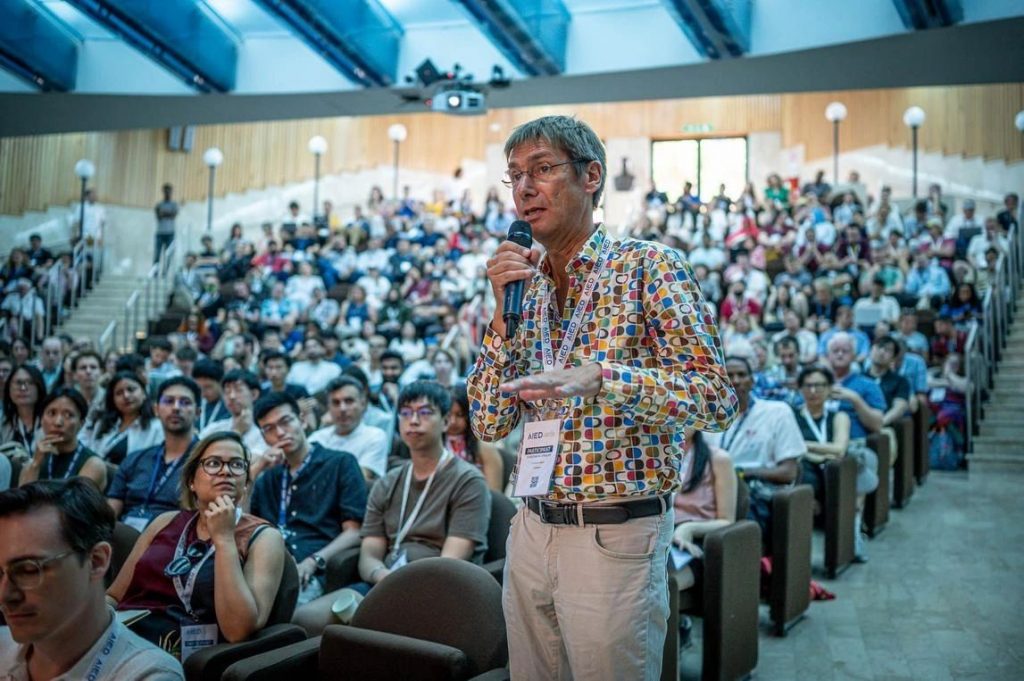
The Artificial Intelligence and Education (AIED) conference celebrated its 25th anniversary and a record number of participants. Over 500 researchers from all over the world came together to discuss the most pressing questions and latest research findings relating to artificial intelligence (AI) and education. The Rheinische Friedrich-Wilhelms-Universität Bonn was represented at AIED 2024 in the Brazilian metropolis of Recife by me.

As the research coordinator of the scientific University IT and Data Centre, I presented the first systematic literature analysis on the ethical issues of AI and Education (AI&ED), which had been selected as a scientific paper in an anonymous procedure (double-blind peer review). I was also able to present the successful teaching and learning project ‘Virtual Collaboration’ (called ViCo: https://www.vico.uni-bonn.de) and the first handout for teachers in universities from the European network ‘Ethical Use of AI’ (https://ethischeki.ecompetence.eu).

My second submission was also successful: a half-day interactive workshop on the topic of AI regulation was also accepted in a double-blind peer review process. As an appointed member of the AI&ED Expert Group of the Council of Europe, I gave an introduction to current developments, to which I could also welcome Ahmet-Murat Kilic from the Council of Europe. Afterwards, I moderated the workshop and facilitated small working groups using the World Café method.

The interest, enquiries and feedback on the research results were outstanding and the AIED 2024 conference enjoyed active participation and great popularity overall. The largest Brazilian TV station Globo reported on site and also interviewed me as international AI&ED expert to share my view.

All scientific publications and the presentations are published on the homepage https://opening-up.education/events and the results of the workshop are presented on its website http://aied2024.learning-innovations.eu

My invited speech at EUNIS 2024

I was pleased to be invited speaker at the Congress EUNIS 2024 in Athens:

On 4th of June 2024, I was explaining the current situation in relattion to the use of Artificial Intelligence (AI).

My title was “Artificial Intelligence Regulation” and I was mainly focusing the AI Act and the upcoming law for using AI in education.

The AI Act as a general approach is applicable for all sectors. It is based on an impact assessment and the distinction between four levels of potential AI risks. During the development, generative AI (genAI) became popular and it was introduced as an addition category maybe causing future conflict with the four risk levels.

Education is a special sector that requires special attention:
Therefore, the Council of Europe and its appointed AI&ED Expert Group are working on a complementary law especially for the use of AI in education. It will set the framework and boundaries for ethical AI use in teaching and learning processes.

More about EUNIS 2024 and the AI workshop: https://eunis.org/blog/events/security-challenges-and-the-benefits-of-ai/

My slides are available here: https://doi.org/10.5281/zenodo.11568575

First Handout for AI in Higher Education published

Guideline for University Teachers adopted by the Network ‘Ethical use of AI’

The German Network ‘Ethical use of AI’ has been working on a handout entitled ‘What is artificial intelli-gence (AI)?’ over the past few months and has now adopted and published it on 7th of March 2024. This first guide consists of 10 statements and a question-and-answer list together with practical recommenda-tions on two pages. It is aimed at university lecturers who want to introduce and use AI systems in their teaching.

‘We chose the short form of a handout on AI because there are already numerous studies and scientific papers on the use of AI, but so far no concise introduction that we can pass on to interested parties without prior knowledge,’ explains the head of the network Dr Christian M. Stracke from the University of Bonn. The handout closes this gap and can be used, modified and reused as desired thanks to the open and free li-cence with reference to the source.

The Network ‘Ethical use of AI’ brings together teachers and researchers from over 30 universities who also organise further education courses on how AI can change university teaching and society as a whole. Expe-rience has shown that there is huge interest in the opportunities and potential applications of AI, but there are also fears of risks and negative effects. It is therefore all the more important to provide teachers, uni-versity management and policy makers with basic information and specific practical recommendations, such as those offered for the first time in this handbook.

The independent network has now established itself as a lively community and open platform for the in-formal exchange of ideas and experiences. It deals with the personal, organisational and legal challenges of AI offerings for their ethical and trustworthy introduction and use. Since the founding meeting on 11th of May 2023, the network has met regularly once a month to exchange ideas and all interested parties are welcome to attend. It was initiated and is moderated by AI expert Christian M. Stracke from the University of Bonn, who researches AI and open education and was appointed as a member of the European AI&ED Expert Group by the Council of Europe.

Download of the German AI handout: https://doi.org/10.5281/zenodo.10793844

English translation of the AI handout: https://doi.org/10.5281/zenodo.10995669

Website of the German Network: https://ethischeki.ecompetence.eu